
— TREATMENT AREA
Psychological Safety & Trauma-Informed Leadership
Leadership is extraordinary work. It can also be one of the loneliest, most pressure-filled places to carry unresolved mental health. You take care of everyone else, let us help you take care of yourself.

— YOUR STORY
The Weight No One Sees You Carrying
You have built something, a team, a department, a career. You are the one people come to when things go wrong, when decisions need to be made, when the room needs a steady hand. You have learned to wear composure like a second skin.
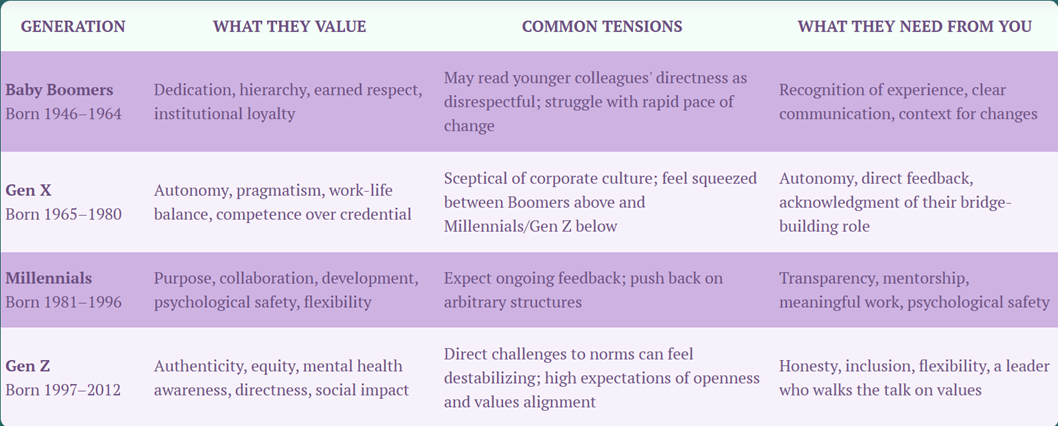
And in the space between meetings, you are exhausted in a way you can't fully explain to anyone. Because how do you tell the people who depend on you that you are running on empty? How do you admit that the cross-generational tension on your team is taking a toll on your mental health?
"I knew exactly what everyone on my team needed. What I couldn't see was what I needed. By the time I admitted I was struggling, I was already in burnout."
Psychological safety is not a corporate buzzword. It is the difference between a team that performs from fear and one that performs from genuine engagement. And it starts, always, with the person at the top of the room.
"I came in thinking I needed strategies for my team. What I found was that my team's dysfunction was partly a mirror of patterns I hadn't examined in myself. That was humbling, and ultimately the most important thing I've ever done as a leader."
— A senior leader working with IHC

— THE MULTIGENERATIONAL WORKPLACE
Four Generations, One Team, And the Tension Between Them
— WHAT WE BUILD TOGETHER
The Four Pillars of
Psychologically Safe Leadership
💪 The leader's own foundation
None of the above is sustainable if the leader is not also attending to their own mental health, self-awareness, and regulatory capacity.
🗣️ Voice without fear
Creating conditions where team members can speak up, flag problems, and share ideas without fear of humiliation or reprisal.
🤝 Belonging for all
Every team member, across generations, identities, and working styles, feels like they genuinely belong in the room and in the vision.
🔍 Curiosity over blame
Shifting from reactive blame cultures to genuine inquiry, where mistakes are information, and learning is a shared goal.
— TWO TRACKS OF SUPPORT
Supporting the Leader and the Team They Build
For the leader as a culture builder
Consultative therapeutic support focused on team dynamics, cross-generational tension, psychological safety frameworks, and trauma-informed management practices.
Moving from a culture of performance anxiety to one of genuine psychological safety, accountability, and belonging.
For the leader as a person
Individual therapy focused on the personal psychological landscape of leadership. Processing burnout, perfectionistic patterns, the loneliness of authority, and the unresolved material that gets activated under pressure.
A space that is entirely yours, where the mask comes off, and the real work of self-understanding begins.
The Best Leaders Know
When to Ask for Support
Seeking therapy is not a sign that you can't handle it. It is a sign that you understand the weight of what you carry, and you're wise enough to share it.